Practice PCEP-30-02 Test Engine, New PCEP-30-02 Exam Experience
Wiki Article
P.S. Free 2026 Python Institute PCEP-30-02 dumps are available on Google Drive shared by ActualPDF: https://drive.google.com/open?id=1qmKwpZzLWcQrk56tfzIA50WV96PYQ3zb
There are three versions of PCEP-30-02 training materials for the candidate of you, and different versions have different advantages, you can use it in accordance with your own habit. Free update for each version for one year, namely, you don’t need to buy the same version for many times, and the update version will send to you automatically. You will get the latest version of PCEP-30-02 Training Materials.
Python Institute PCEP-30-02 Exam Syllabus Topics:
| Topic | Details |
|---|---|
| Topic 1 |
|
| Topic 2 |
|
| Topic 3 |
|
| Topic 4 |
|
| Topic 5 |
|
>> Practice PCEP-30-02 Test Engine <<
Most Effective Way to Get Python Institute PCEP-30-02 Certification
As you know, your company will introduce new talent each year. In the face of their excellent resume, you must improve your strength to keep your position! Our PCEP-30-02 study questions may be able to give you some help. What you need may be an internationally-recognized PCEP-30-02 certificate, perhaps using the time available to complete more tasks. With our PCEP-30-02 study materials, you will copyright in the shortest possible time.
Python Institute PCEP - Certified Entry-Level Python Programmer Sample Questions (Q24-Q29):
NEW QUESTION # 24
Assuming that the following assignment has been successfully executed:
Which of the following expressions evaluate to True? (Select two expressions.)
- A. len (the list [0:2]} <3
- B. the_list. index {'1'} -- 0
- C. the_List.index {"1"} in the_list
- D. 1.1 in the_list |1:3 |
Answer: A,B
Explanation:
The code snippet that you have sent is assigning a list of four values to a variable called "the_list". The code is as follows:
the_list = ['1', 1, 1, 1]
The code creates a list object that contains the values '1', 1, 1, and 1, and assigns it to the variable "the_list".
The list can be accessed by using the variable name or by using the index of the values. The index starts from
0 for the first value and goes up to the length of the list minus one for the last value. The index can also be negative, in which case it counts from the end of the list. For example, the_list[0] returns '1', and the_list[-1] returns 1.
The expressions that you have given are trying to evaluate some conditions on the list and return a boolean value, either True or False. Some of them are valid, and some of them are invalid and will raise an exception.
An exception is an error that occurs when the code cannot be executed properly. The expressions are as follows:
A). the_List.index {"1"} in the_list: This expression is trying to check if the index of the value '1' in the list is also a value in the list. However, this expression is invalid, because it uses curly brackets instead of parentheses to call the index method. The index method is used to return the first occurrence of a value in a list. For example, the_list.index('1') returns 0, because '1' is the first value in the list. However, the_list.index
{"1"} will raise a SyntaxError exception and output nothing.
B). 1.1 in the_list |1:3 |: This expression is trying to check if the value 1.1 is present in a sublist of the list.
However, this expression is invalid, because it uses a vertical bar instead of a colon to specify the start and end index of the sublist. The sublist is obtained by using the slicing operation, which uses square brackets and a colon to get a part of the list. For example, the_list[1:3] returns [1, 1], which is the sublist of the list from the index 1 to the index 3, excluding the end index. However, the_list |1:3 | will raise a SyntaxError exception and output nothing.
C). len (the list [0:2]} <3: This expression is trying to check if the length of a sublist of the list is less than 3.
This expression is valid, because it uses the len function and the slicing operation correctly. The len function is used to return the number of values in a list or a sublist. For example, len(the_list) returns 4, because the list has four values. The slicing operation is used to get a part of the list by using square brackets and a colon. For example, the_list[0:2] returns ['1', 1], which is the sublist of the list from the index 0 to the index 2, excluding the end index. The expression len (the list [0:2]} <3 returns True, because the length of the sublist ['1', 1] is 2, which is less than 3.
D). the_list. index {'1'} - 0: This expression is trying to check if the index of the value '1' in the list is equal to 0. This expression is valid, because it uses the index method and the equality operator correctly. The index method is used to return the first occurrence of a value in a list. For example, the_list.index('1') returns 0, because '1' is the first value in the list. The equality operator is used to compare two values and return True if they are equal, or False if they are not. For example, 0 == 0 returns True, and 0 == 1 returns False. The expression the_list. index {'1'} - 0 returns True, because the index of '1' in the list is 0, and 0 is equal to 0.
Therefore, the correct answers are C. len (the list [0:2]} <3 and D. the_list. index {'1'} - 0.
Reference: Python List Methods - W3Schools5. Data Structures - Python 3.11.5 documentationList methods in Python - GeeksforGeeks
NEW QUESTION # 25
What happens when the user runs the following code?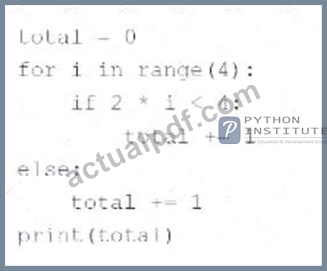
- A. The code outputs 1.
- B. The code outputs 3.
- C. The code enters an infinite loop.
- D. The code outputs 2.
Answer: D
Explanation:
The code snippet that you have sent is calculating the value of a variable "total" based on the values in the range of 0 to 3. The code is as follows:
total = 0 for i in range(0, 3): if i % 2 == 0: total = total + 1 else: total = total + 2 print(total) The code starts with assigning the value 0 to the variable "total". Then, it enters a for loop that iterates over the values 0, 1, and 2 (the range function excludes the upper bound). Inside the loop, the code checks if the current value of "i" is even or odd using the modulo operator (%). If "i" is even, the code adds 1 to the value of "total". If "i" is odd, the code adds 2 to the value of "total". The loop ends when "i" reaches 3, and the code prints the final value of "total" to the screen.
The code outputs 2 to the screen, because the value of "total" changes as follows:
* When i = 0, total = 0 + 1 = 1
* When i = 1, total = 1 + 2 = 3
* When i = 2, total = 3 + 1 = 4
* When i = 3, the loop ends and total = 4 is printed
Therefore, the correct answer is B. The code outputs 2.
Reference: [Python Institute - Entry-Level Python Programmer Certification]
NEW QUESTION # 26
What is true about tuples? (Select two answers.)
- A. The len { } function cannot be applied to tuples.
- B. Tuples are immutable, which means that their contents cannot be changed during their lifetime.
- C. Tuples can be indexed and sliced like lists.
- D. An empty tuple is written as { } .
Answer: B,C
Explanation:
Tuples are one of the built-in data types in Python that are used to store collections of data. Tuples have some characteristics that distinguish them from other data types, such as lists, sets, and dictionaries. Some of these characteristics are:
* Tuples are immutable, which means that their contents cannot be changed during their lifetime. Once a tuple is created, it cannot be modified, added, or removed. This makes tuples more stable and reliable than mutable data types. However, this also means that tuples are less flexible and dynamic than mutable data types. For example, if you want to change an element in a tuple, you have to create a new tuple with the modified element and assign it to the same variable12
* Tuples are ordered, which means that the items in a tuple have a defined order and can be accessed by using their index. The index of a tuple starts from 0 for the first item and goes up to the length of the tuple minus one for the last item. The index can also be negative, in which case it counts from the end of the tuple. For example, if you have a tuple t = ("a", "b", "c"), then t[0] returns "a", and t
[-1] returns "c"12
* Tuples can be indexed and sliced like lists, which means that you can get a single item or a sublist of a tuple by using square brackets and specifying the start and end index. For example, if you have a tuple t
= ("a", "b", "c", "d", "e"), then t[2] returns "c", and t[1:4] returns ("b", "c", "d"). Slicing does not raise any exception, even if the start or end index is out of range. It will just return an empty tuple or the closest possible sublist12
* Tuples can contain any data type, such as strings, numbers, booleans, lists, sets, dictionaries, or even other tuples. Tuples can also have duplicate values, which means that the same item can appear more than once in a tuple. For example, you can have a tuple t = (1, 2, 3, 1, 2), which contains two 1s and two
2s12
* Tuples are written with round brackets, which means that you have to enclose the items in a tuple with parentheses. For example, you can create a tuple t = ("a", "b", "c") by using round brackets. However, you can also create a tuple without using round brackets, by just separating the items with commas. For example, you can create the same tuple t = "a", "b", "c" by using commas. This is called tuple packing, and it allows you to assign multiple values to a single variable12
* The len() function can be applied to tuples, which means that you can get the number of items in a tuple by using the len() function. For example, if you have a tuple t = ("a", "b", "c"), then len(t) returns 312
* An empty tuple is written as (), which means that you have to use an empty pair of parentheses to create a tuple with no items. For example, you can create an empty tuple t = () by using empty parentheses.
However, if you want to create a tuple with only one item, you have to add a comma after the item, otherwise Python will not recognize it as a tuple. For example, you can create a tuple with one item t = ("a",) by using a comma12 Therefore, the correct answers are A. Tuples are immutable, which means that their contents cannot be changed during their lifetime. and D. Tuples can be indexed and sliced like lists.
Reference: Python Tuples - W3SchoolsTuples in Python - GeeksforGeeks
NEW QUESTION # 27
Arrange the binary numeric operators in the order which reflects their priorities, where the top-most position has the highest priority and the bottom-most position has the lowest priority.
Answer:
Explanation:
Explanation: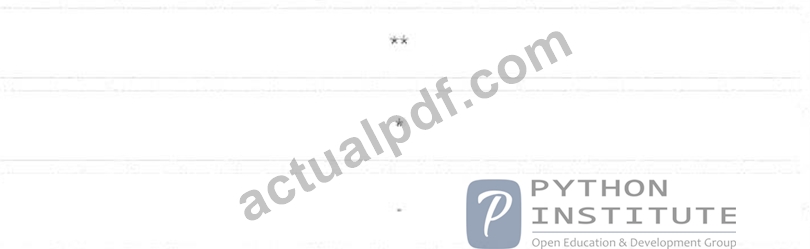
The correct order of the binary numeric operators in Python according to their priorities is:
* Exponentiation (**)
* Multiplication (*) and Division (/, //, %)
* Addition (+) and Subtraction (-)
This order follows the standard mathematical convention of operator precedence, which can be remembered by the acronym PEMDAS (Parentheses, Exponents, Multiplication/Division, Addition/Subtraction).
Operators with higher precedence are evaluated before those with lower precedence, but operators with the same precedence are evaluated from left to right. Parentheses can be used to change the order of evaluation by grouping expressions.
For example, in the expression 2 + 3 * 4 ** 2, the exponentiation operator (**) has the highest priority, so it is evaluated first, resulting in 2 + 3 * 16. Then, the multiplication operator (*) has the next highest priority, so it is evaluated next, resulting in 2 + 48. Finally, the addition operator (+) has the lowest priority, so it is evaluated last, resulting in 50.
You can find more information about the operator precedence in Python in the following references:
* 6. Expressions - Python 3.11.5 documentation
* Precedence and Associativity of Operators in Python - Programiz
* Python Operator Priority or Precedence Examples Tutorial
NEW QUESTION # 28
What is the expected output of the following code?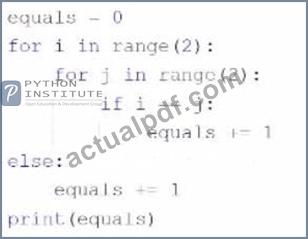
- A. The code outputs nothing.
- B. 0
- C. 1
- D. 2
Answer: B
Explanation:
Explanation
The code snippet that you have sent is checking if two numbers are equal and printing the result. The code is as follows:
num1 = 1 num2 = 2 if num1 == num2: print(4) else: print(1)
The code starts with assigning the values 1 and 2 to the variables "num1" and "num2" respectively. Then, it enters an if statement that compares the values of "num1" and "num2" using the equality operator (==). If the values are equal, the code prints 4 to the screen. If the values are not equal, the code prints 1 to the screen.
The expected output of the code is 1, because the values of "num1" and "num2" are not equal. Therefore, the correct answer is C. 1.
NEW QUESTION # 29
......
PCEP-30-02 exam training allows you to pass exams in the shortest possible time. If you do not have enough time, our study material is really a good choice. In the process of your learning, our study materials can also improve your efficiency. If you don't have enough time to learn, PCEP-30-02 test guide will make the best use of your spare time, and the scattered time will add up. The service of PCEP-30-02 Test Guide is very prominent. It always considers the needs of customers in the development process. There are three versions of our PCEP-30-02 learning question, PDF, PC and APP. Each version has its own advantages. You can choose according to your needs.
New PCEP-30-02 Exam Experience: https://www.actualpdf.com/PCEP-30-02_exam-dumps.html
- Valid PCEP-30-02 Exam Materials ???? PCEP-30-02 Reliable Exam Papers ???? Practice PCEP-30-02 Exams ???? Download 「 PCEP-30-02 」 for free by simply entering ➥ www.practicevce.com ???? website ????Official PCEP-30-02 Practice Test
- PCEP-30-02 Exam Sample Online ???? PCEP-30-02 Reliable Exam Papers ???? Valid PCEP-30-02 Exam Materials ???? ✔ www.pdfvce.com ️✔️ is best website to obtain “ PCEP-30-02 ” for free download ????PCEP-30-02 Reliable Exam Papers
- 100% Pass Quiz Newest PCEP-30-02 - Practice PCEP - Certified Entry-Level Python Programmer Test Engine ???? Enter ➡ www.exam4labs.com ️⬅️ and search for ⏩ PCEP-30-02 ⏪ to download for free ????PCEP-30-02 Valid Exam Experience
- Get Access To Python Institute PCEP-30-02 Questions Using Three Different Formats ???? ▶ www.pdfvce.com ◀ is best website to obtain ➤ PCEP-30-02 ⮘ for free download ????Latest PCEP-30-02 Test Question
- PCEP-30-02 Dumps Cost ???? PCEP-30-02 Exam Sample Online ☁ New PCEP-30-02 Exam Bootcamp ???? Search for 「 PCEP-30-02 」 and download it for free on ➥ www.exam4labs.com ???? website ????Latest PCEP-30-02 Test Question
- New PCEP-30-02 Exam Bootcamp ???? Valid PCEP-30-02 Mock Exam ???? Study PCEP-30-02 Material ???? Open website ➥ www.pdfvce.com ???? and search for ➠ PCEP-30-02 ???? for free download ????Guide PCEP-30-02 Torrent
- Valid PCEP-30-02 Mock Exam ???? Practice PCEP-30-02 Exams ???? Valid Dumps PCEP-30-02 Ebook ???? Search for ➥ PCEP-30-02 ???? on 「 www.examcollectionpass.com 」 immediately to obtain a free download ????Practice PCEP-30-02 Exams
- Newest Practice PCEP-30-02 Test Engine – 100% Pass-Sure New PCEP - Certified Entry-Level Python Programmer Exam Experience ???? Download ➥ PCEP-30-02 ???? for free by simply searching on 【 www.pdfvce.com 】 ????Valid Dumps PCEP-30-02 Ebook
- Free PDF Quiz Python Institute - PCEP-30-02 - PCEP - Certified Entry-Level Python Programmer Latest Practice Test Engine ???? Copy URL ➠ www.practicevce.com ???? open and search for ✔ PCEP-30-02 ️✔️ to download for free ????New PCEP-30-02 Test Materials
- Original PCEP-30-02 Questions ???? Valid Exam PCEP-30-02 Book ???? Original PCEP-30-02 Questions ???? ⏩ www.pdfvce.com ⏪ is best website to obtain ⮆ PCEP-30-02 ⮄ for free download ????Original PCEP-30-02 Questions
- PCEP-30-02 Dumps Cost ⚠ PCEP-30-02 Dumps Cost ???? Valid PCEP-30-02 Mock Exam ???? Open ➡ www.practicevce.com ️⬅️ and search for [ PCEP-30-02 ] to download exam materials for free ????Valid PCEP-30-02 Exam Materials
- github.com, neilhgnp487994.59bloggers.com, jayasnwm755401.wikiap.com, webookmarks.com, ez-bookmarking.com, matteoblxr691829.techionblog.com, saulqwgy405444.blogsvila.com, fraseraebm562026.wikiconverse.com, bookmarkswing.com, dillantsrv610958.wikilowdown.com, Disposable vapes
P.S. Free & New PCEP-30-02 dumps are available on Google Drive shared by ActualPDF: https://drive.google.com/open?id=1qmKwpZzLWcQrk56tfzIA50WV96PYQ3zb
Report this wiki page